Quantum-Native Security Infrastructure
QNSI
Quantum-Native Security Infrastructure
- Availability
- Available
Overview
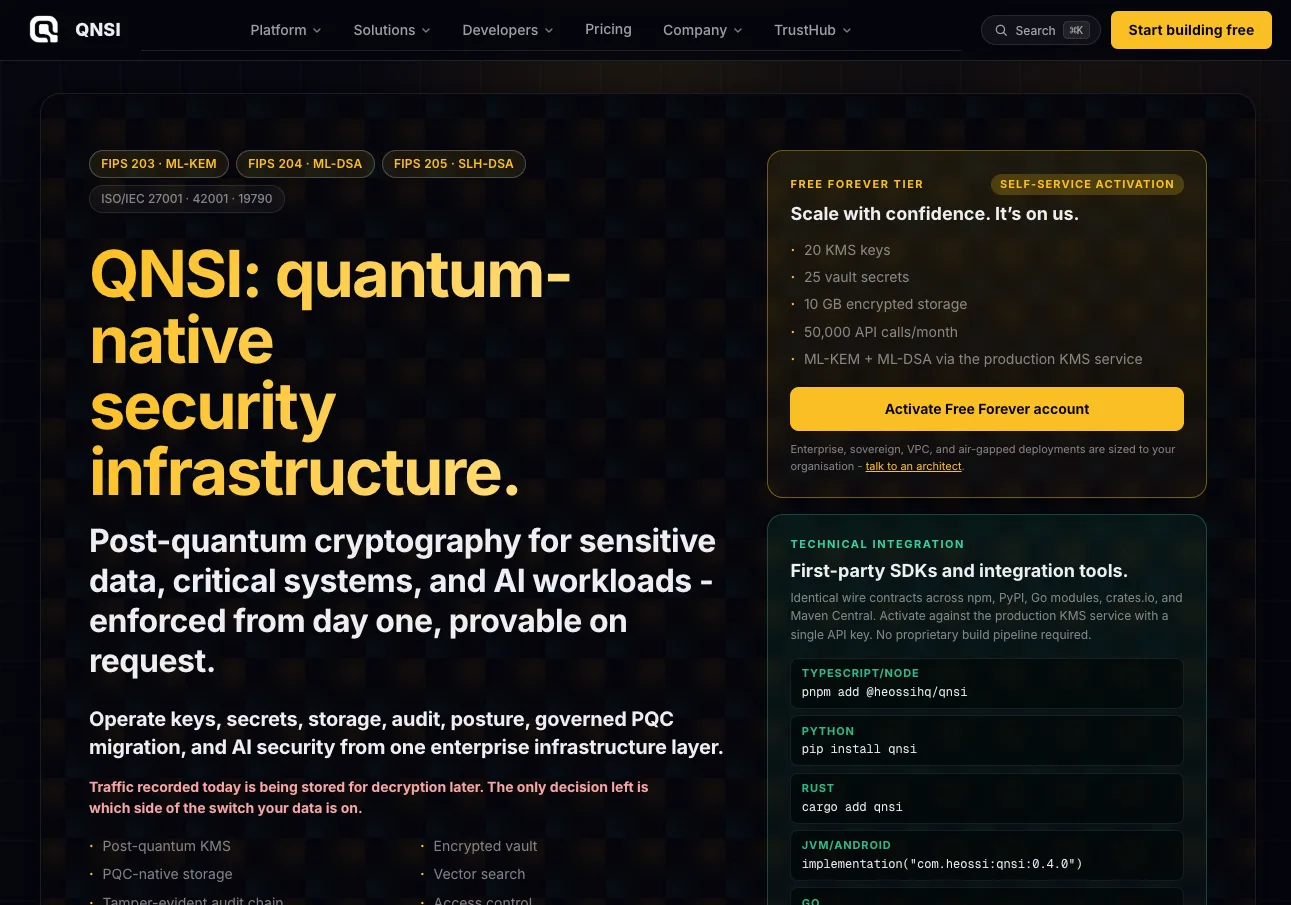
QNSI is HEOSSI's quantum-native security infrastructure and the cryptographic trust layer of XIIS. Its current public contract reports 72 post-quantum algorithms across 13 families, including NIST-finalized ML-KEM, ML-DSA, and SLH-DSA (FIPS 203/204/205). It publishes reproducible ACVP evidence, maps 17 controls across 3 compliance frameworks without claiming certification, and provides 8 BYOHSM connector implementations (6 via PKCS#11 and 2 via REST). Hardware qualification and cryptographic-boundary claims remain provider-, configuration-, and deployment-specific.
- 72 (13 families)
- PQC Algorithms
- 3 frameworks / 17 controls
- Control Mapping
- 435/435
- Noble ACVP
- 240/240
- liboqs ACVP
- 8
- BYOHSM Connectors
- $0
- Free Tier
Evidence pack
Every claim on this page traces to a record below - facts contracts, conformance evidence and published artifacts.
Published surface
Stack capabilities
What QNSI delivers
- 72 post-quantum algorithms (27 KEMs and 45 signatures) across 13 families
- 4 per-tenant cryptographic policy tiers
- Reproducible software conformance vectors are published at qnsi.heossi.com/verify/conformance; software conformance is not certification of a deployed cryptographic module
- 3 compliance frameworks mapped to 17 controls; mappings are not certifications
- 8 BYOHSM connector implementations: 6 via PKCS#11 and 2 via REST, with qualification remaining deployment-specific
- Native-PQC HSM and cloud-KMS offerings now exist; AWS KMS exposes ML-DSA-44/65/87, while other providers expose different mechanism sets and validation scopes. Prefer a provider's native operation when the exact approved deployment supports it. QNSI's current HSPK API is the ML-DSA-44/65/87 compatibility path for existing qualified PKCS#11 estates: the HSM protects the RSA-OAEP custody root and QNSI performs ML-DSA in software. QNSI's 72-algorithm catalog remains a broader software migration and interoperability surface-not a claim that all 72 execute in hardware.
- NIST-finalized ML-KEM, ML-DSA, and SLH-DSA (FIPS 203/204/205)
Use cases
Where QNSI is applied
25 representative scenarios from QNSI’s 100-case post-quantum migration library, each linking to the canonical entry.
Interfaces and modules
Integration surfaces
- 8 published SDK/MCP integrations (TypeScript/Node, Python, Rust, JVM/Android, Go, Swift (iOS/macOS), Device PQC (JVM/Android), MCP)
- REST APIs (OpenAPI)
- WebSocket API
- CLI tools
Deployment
Where it runs
Managed service with a $0 free tier (10 GB storage, 50,000 API calls, 20 KMS keys, and 25 vault secrets); private deployment options are subject to qualification.
Third-Party Services & Dependencies
HEOSSI solutions integrate with and depend on third-party services including blockchain networks, cloud infrastructure providers, cryptographic libraries, identity providers, and certificate authorities.
HEOSSI is not responsible for:
- Availability, performance, or security of third-party services
- Changes to third-party APIs, protocols, or standards
- Third-party service outages, breaches, or failures
- Costs associated with third-party services
- Compliance of third-party services with applicable laws
Performance metrics and capabilities may be affected by third-party service limitations. Customers are responsible for evaluating and accepting risks associated with third-party dependencies.
FAQ
Common questions about QNSI
What is post-quantum cryptography and why do I need it now?
Post-quantum cryptography (PQC) uses algorithms resistant to both classical and quantum computer attacks. You need it now because adversaries are harvesting encrypted data today to decrypt later when quantum computers become available - known as 'harvest now, decrypt later' (HNDL) attacks. QNSI implements all NIST-finalized PQC standards (ML-KEM, ML-DSA, SLH-DSA) to protect your data against future quantum threats.
How does QNSI compare to other PQC solutions?
QNSI is an enterprise PQC solution implementing NIST FIPS 203/204/205. It publishes reproducible ACVP conformance evidence and provides deployment-qualified BYOHSM integrations. Current catalogue and connector figures are supplied by its verified solution record.
Is QNSI compliant with NIST and government standards?
Yes. QNSI implements all NIST FIPS finalized standards: FIPS 203 (ML-KEM), FIPS 204 (ML-DSA), and FIPS 205 (SLH-DSA). It supports CNSA 2.0 requirements and offers government-tier crypto policies with HSM-enforced root key protection. Available for air-gapped sovereign deployments.
Can I try QNSI for free?
Yes. QNSI offers a Free Forever tier with 10GB storage, 50,000 API calls per month, 20 KMS keys, and 25 vault secrets - no credit card required. This allows you to evaluate quantum-safe security for your applications before committing to paid plans.
From the editorial
Latest writing on QNSI
Next step
Interested in QNSI?
Discuss deployment options, technical evaluations, and structured pilots with the HEOSSI engineering team.